
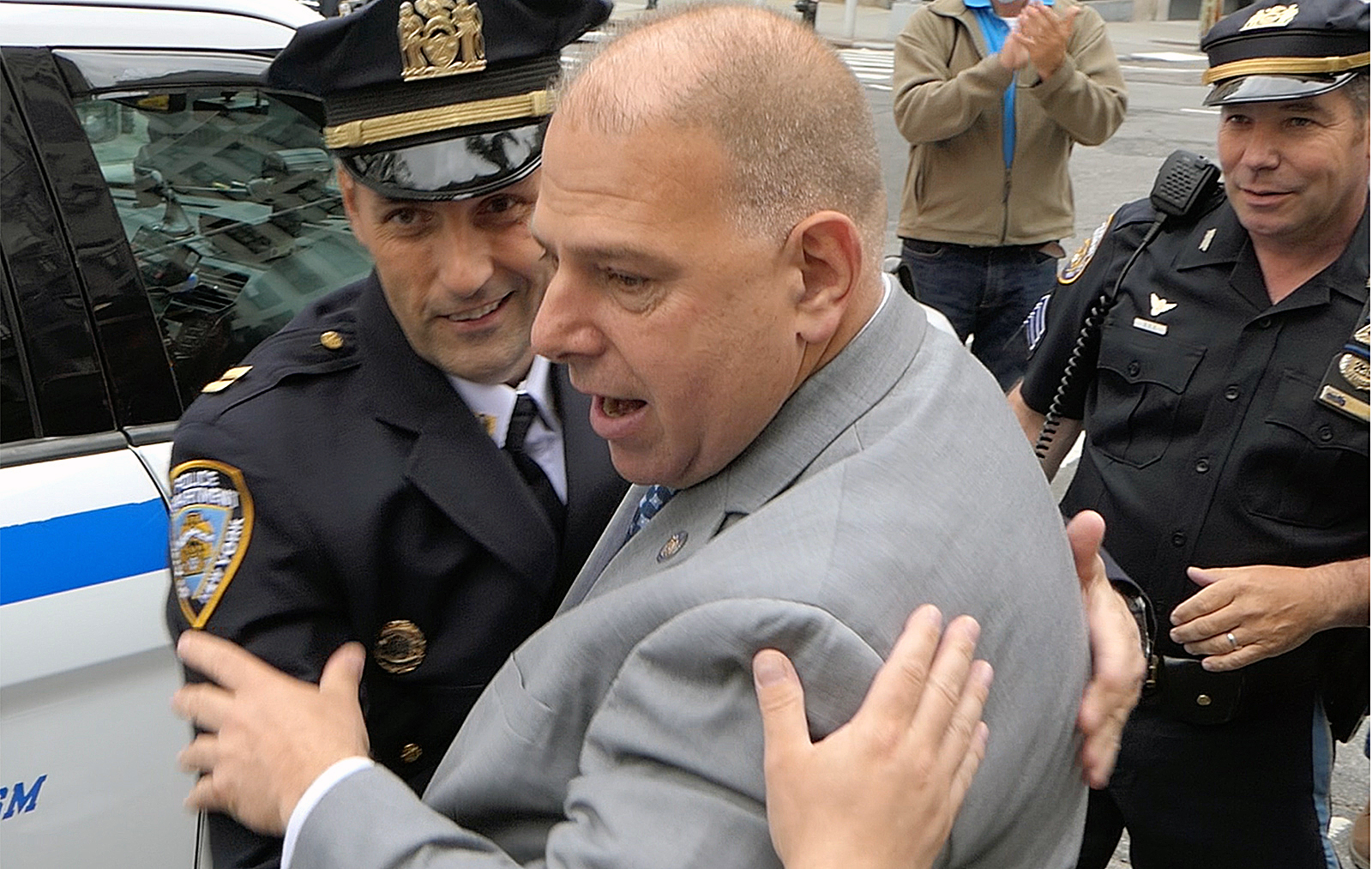
During his "walk-off" celebration, retiring Det. Thomas Moran is embraced by the 1st Precinct's commanding officer, Capt. Thomas Smith. Photo: Carl Glassman/Tribeca Trib
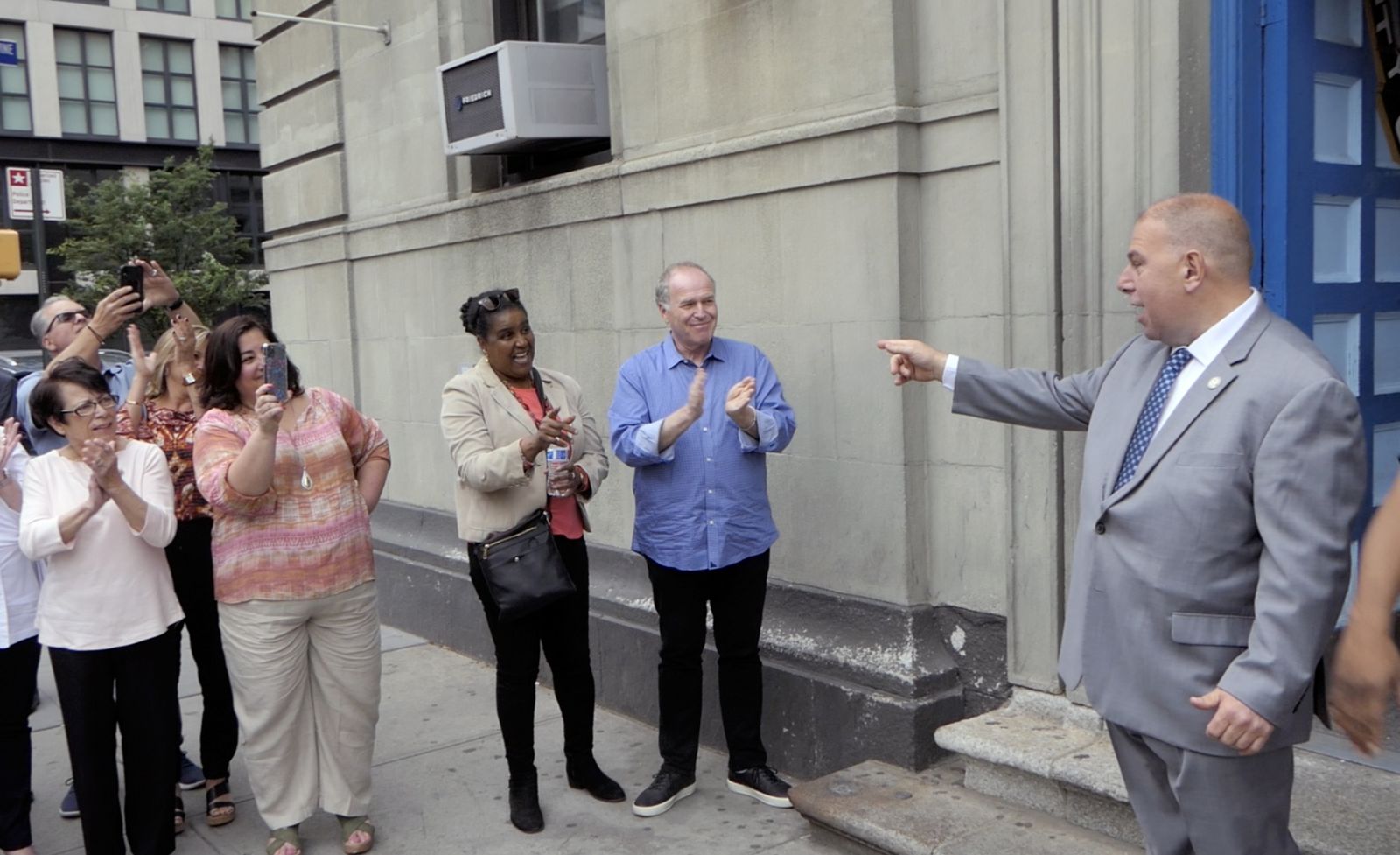
Dressed in his everyday uniform, a suit and tie, Det. Thomas Moran emerged from the 1st Precinct on Friday into the embrace of a cheering crowd waiting to say goodbye to the precinct’s longest-serving cop.
Det. Thomas Moran received a slew of honors before his "walk-off" from the 1st Precinct on May 28, when he was joined by Police Officer Kassiem Griffin, who was retiring after 20 years.
Moran, who spent nearly all his 27-year police career in the Lower Manhattan precinct, was taking the traditional “walk-out” given to retiring members of the force. Since 2004, Moran has been a 1st Precinct community affairs officer, the cop that locals get to know best—and vent complaints to the most.
“He set an example for what community communication could and should be and put a completely different face on the NYPD from a community perspective,” Tammy Meltzer, Community Board 1 chair, said during a ceremony in the station house. “He was always responsive and always kind and gentle with the public, when the public is not always gentle.”
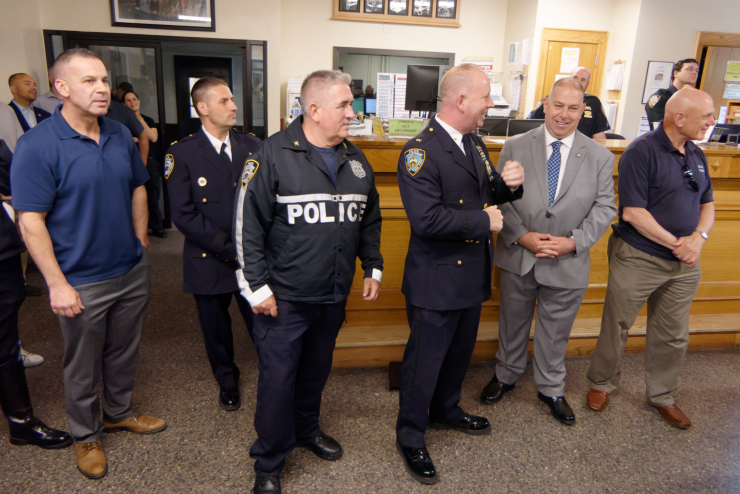 Promoted three times during his community affairs post, most recently to the prestigious rank of Detective First Grade, Moran, 53, was lauded by four former 1st Precinct commanding officers, plus the current precinct chief, Capt. Thomas Smith, who were on hand to honor him.
One of those former bosses, Inspector Mark Iocco, recalled Moran “one of the few who does not say no to anybody.”
“You made my stay here probably the best stay I’ve ever had and it’s all because of you,” Iocco said.
Inspector Michael Hurley said hiring Moran was “without a question the best decision I ever made as a commanding officer. It’s the best decision I’ve made in the 37 years I’ve been on this job.”
“I want to tell all these other guys,” he said, gesturing to the former commanding officers beside him, “they owe me a steak dinner.”
 Following his first year on the job at the 5th Precinct, Moran transferred to the Scooter Patrol, then based in the 1st. He was a few blocks away from the World Trade Center on 9/11, and for months worked on the emotionally wrenching rescue and recovery effort. “That was the hardest thing, going through that,” he recalled. “Seeing that destruction and loss of life.”
During his nine years on patrol, Moran recalled in a phone interview, he made his share of arrests, “but I wasn’t a superstar. I’m better off talking to people.”
Community affairs, he said, “was something I always wanted to do. I always intersected well with people on my beat, knowing the store owner, even the homeless man on the street. I had the skill set to work in community affairs. To be able to communicate well.”
Moran worked thousands of protests, where calming skills with often angry groups can be critical. In the interview, he recalled a demonstration outside 250 Broadway that had spilled into the street and a captain who couldn’t get the protest leader to direct her people back on the sidewalk.
“She had these really long neon-orange fingernails and bright-orange shoes,” the detective recalled, “and I went up to her and I said, ‘I’m Detective Moran, and by the way I love your nails. And I love your shoes.’ She said, ‘Oh thank you.’ I said, ‘I’m here to make sure everybody’s safe and could you kindly help me get your people back on the sidewalk so nobody gets hurt. And she did it.”
 “The captain said, ‘What did you say to her?’ “And I go, ‘Cap, I complimented her first on how lovely her nails and shoes were.’” And he said, ‘That was brilliant.’”
“If you know how to talk to people, you knock down that barrier,” Moran said.
A bigger challenge lay outside City Hall last summer where anti-police protesters had occupied the plaza and Moran acted as a liaison between the NYPD and the organizers. He recalled being able to set some guidelines about hanging objects from trees and erecting structures. But once the leaders left, a more militant fringe group took over and Moran said he didn’t feel safe.
“We had to police that in a very sensitive manner because a lot of the protesters there were agitators and they would want a confrontation. We were trying to handle it with hands off but still have dialogue.”
“They were saying some foul things to me but the way I always operate is I kill them with kindness,” Moran added. “They expect me to escalate to that level and I never played that game. That’s why I did community affairs.”
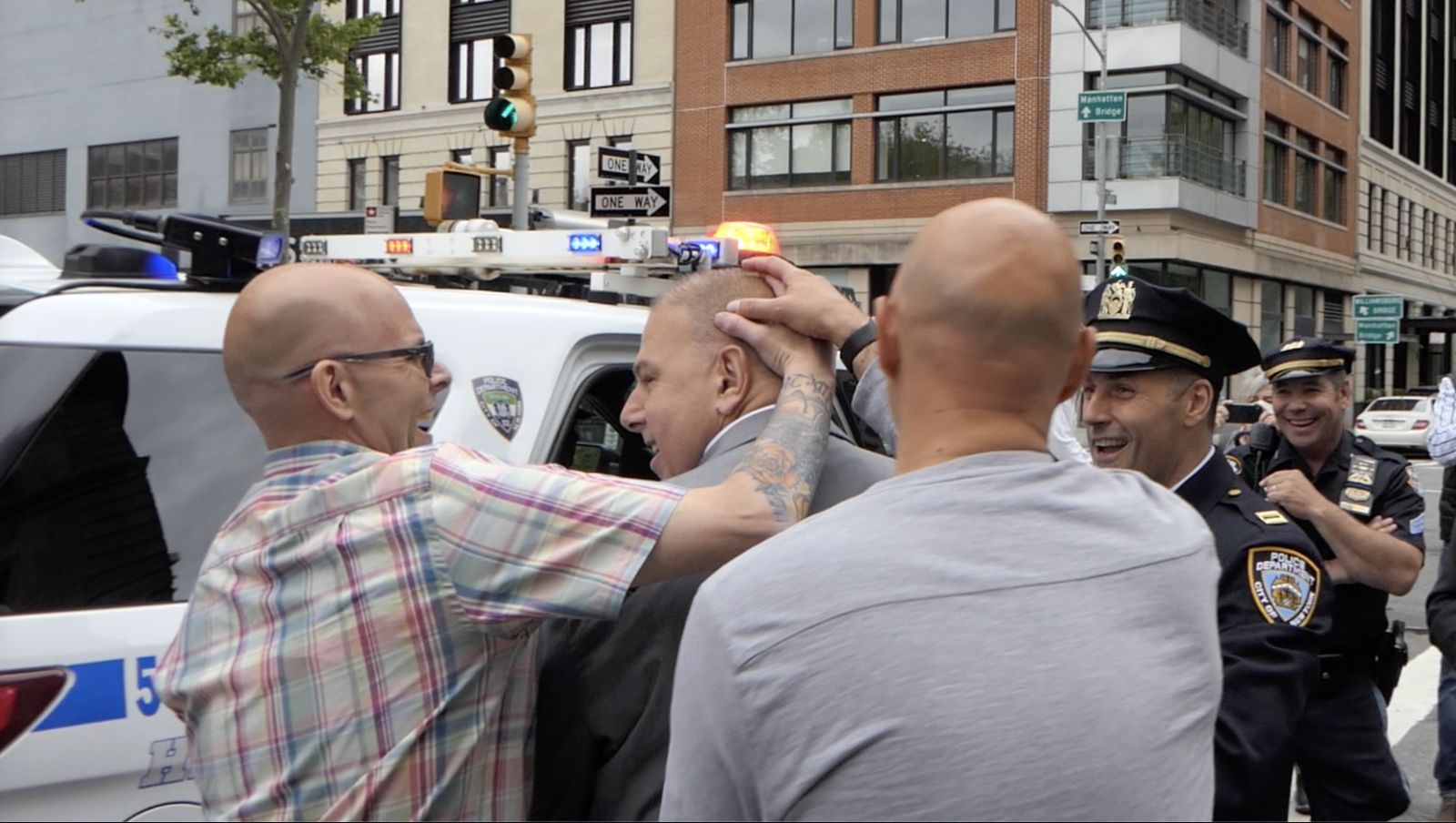
Amid applause and chants of “Tommy! Tommy!” Moran made his way through the crowd, one hug following another, and to a waiting patrol car that would symbolically chauffeur him off to retirement. In a last bit of comradely hijinks, fellow community affairs officers Brian Nelsen and Nick Iordanou ducked their colleague’s head into the back seat, perp style. Then, with a chirp of the siren, the car eased to the corner of Ericsson Place and Varick Street and Detective First Grade Thomas Moran waved goodbye.