
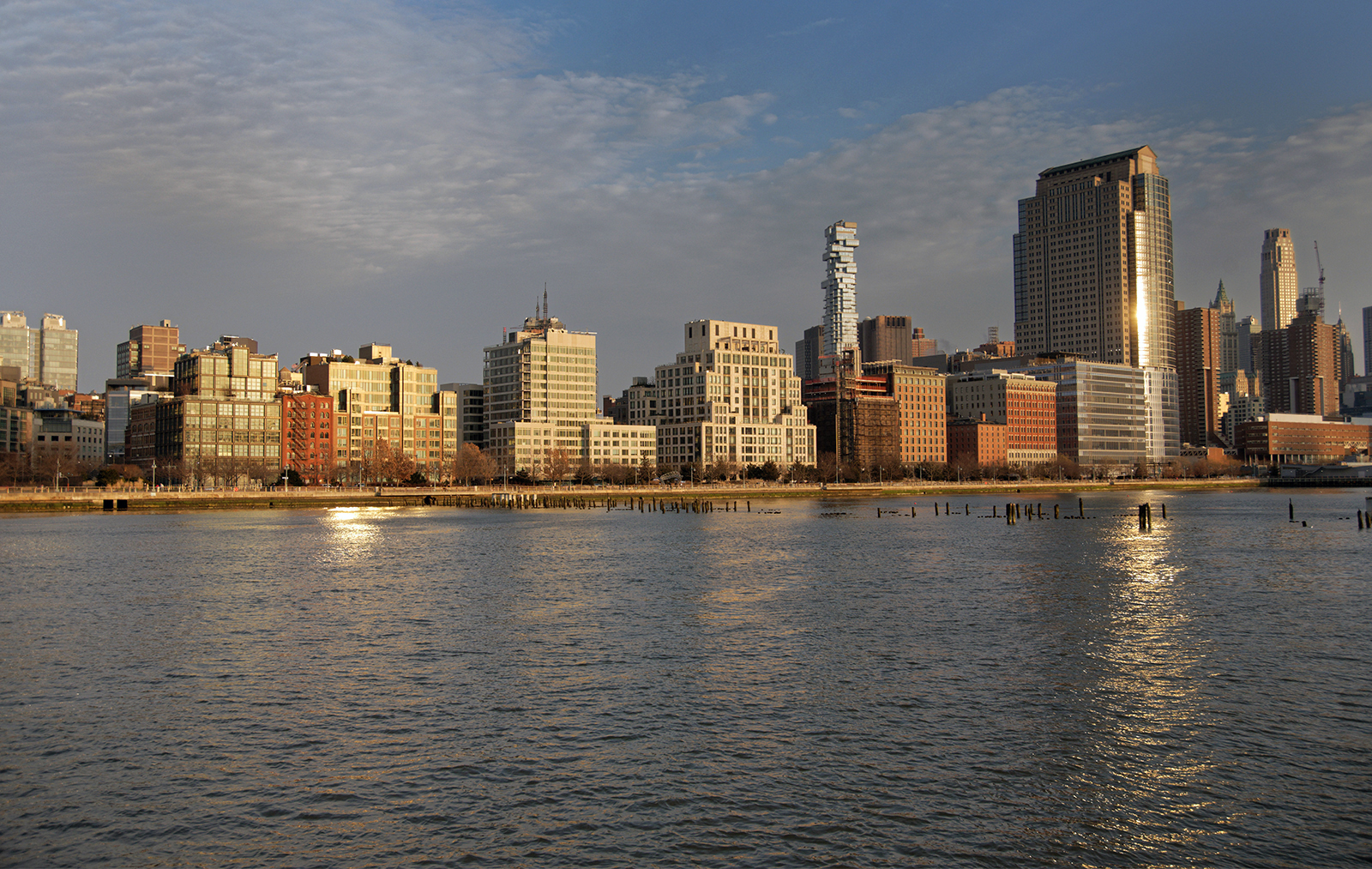
The calm before a future storm surge? Plans to protect Tribeca (above) and much of Manhattan's west side from the ravages of sea level rise are far from complete. Photo: Carl Glassman/Tribeca Trib
For much of Lower Manhattan, planning is well underway for a string of massively complex and costly coastal resiliency projects. But not so for the island’s west side, north of Battery Park City, where efforts lag far behind.
The job is being led by the U.S. Army Corps of Engineers whose study [1], which would eventually inform the plan, was halted two years ago after a pause in federal funding. Now resumed, it is looking at a range of in-water and shoreline-based measures for protecting more than 900 miles of coast along New York and New Jersey. One study area of that expanse is from Tribeca to 34th Street. Unrevised cost estimates by the Corps for protecting the area range from $10 billion to $62 billion, with from 9 years to 25 years needed to complete the projects, according to an Army Corps report.
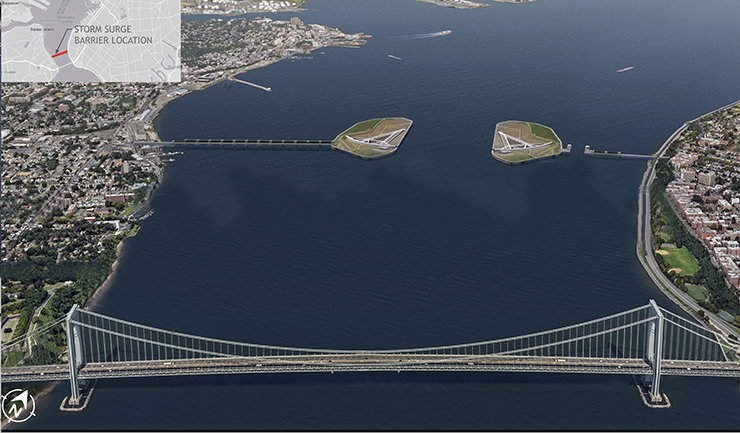 “Projects that can be implemented quicker are better. Nobody wants to wait decades to try to have the protection from the severe storms,” said Bryce Wisemiller, project manager with the Corps, who recently gave Community Board 1’s Environmental Protection Committee a look at the agency’s resiliency planning efforts for the area.
A draft report on the selected plan is expected to be released for review this summer, with the study phase ending in 2024. Then the designing begins. “Hopefully [the report] establishes a framework so that people can get a broad understanding of what type of measure for what areas we think might be best in terms of getting the bigger bang for the buck, and that might be environmentally acceptable,” Wisemiller said.
 Planning and design will go forward, regardless of funding to build it, Wisemiller noted. That’s a whole other hurtle. “Hopefully we get to implement as much of that as support and funding will allow. Once we make a recommendation to Congress, that’s all we do…then it’s up to them whether they want to give us an authorization to build it. And then, of course, after the authorization whether they want to fund it.”
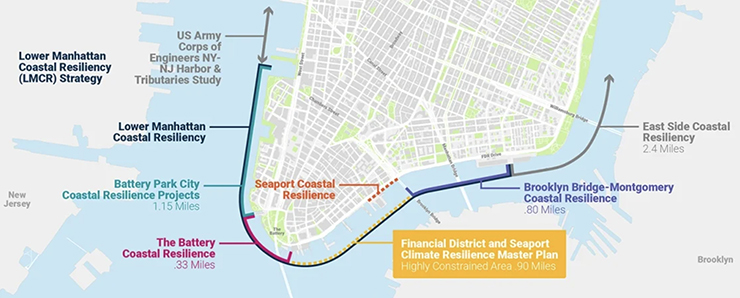
The city-led flood proofing projects [2], in various stages of development, are in four segments, from East 26th Street down to and around the Battery. The Battery Park City Authority is spearheading its own projects [3] to protect that neighborhood, from one end to the other. An Army Corps project would presumably dovetail with Battery Park City’s on the north end.
But of course that could be years, possibly decades, away. Alice Blank, chair of the Environmental Protection Committee asked Wisemiller if the Corps could consider, in the meantime, temporary solutions for Manhattan’s lower west side.
“We haven’t gotten to that level of detail yet,” he responded.
“Just to be clear, there has been absolutely no interim measure that’s been devised for the west side of Manhattan [to 34th Street],” Blank said. “That’s a really critical point, and a critical area, and there’s nothing,” she added. “So we could use some help.”
Links:
[1] https://www.nan.usace.army.mil/Missions/Civil-Works/Projects-in-New-York/New-York-New-Jersey-Harbor-Tributaries-Focus-Area-Feasibility-Study/
[2] https://edc.nyc/project/lower-manhattan-coastal-resiliency
[3] https://bpca.ny.gov/nature-and-sustainability/resiliency/