
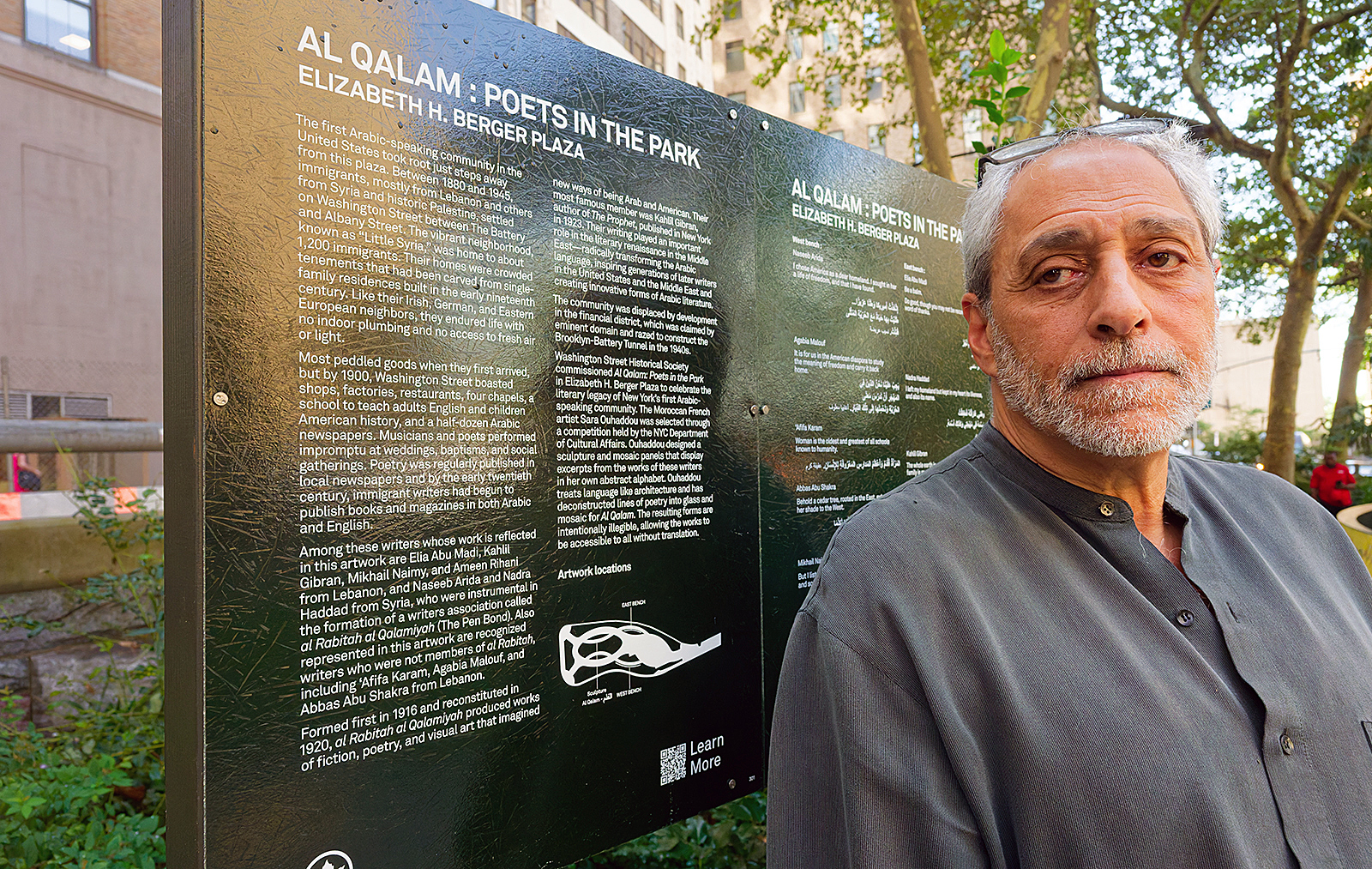
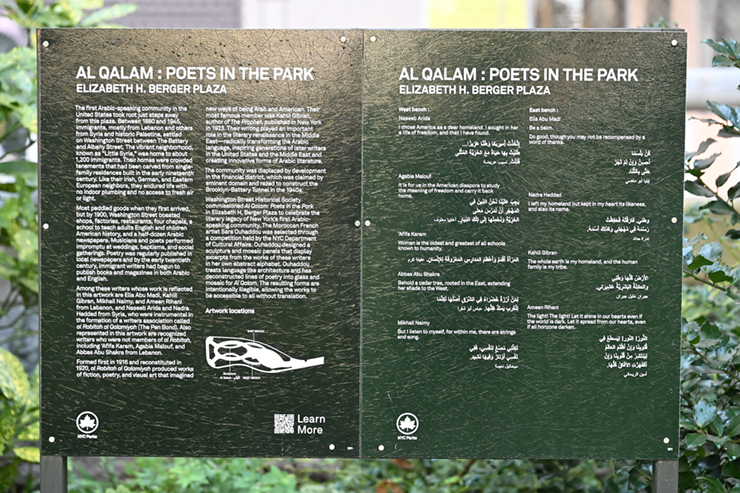
Bob Madey, whose grandfather was a member of the Pen League, called the revised sign, at left, an "erasure of the writers and what they wrote about, how they stood on the colonialist project, and how they saw themselves." Photo: Carl Glassman/Tribeca Trib
Update 8/30/26: At Community Board 1's Executive Committee meeting this month, Jennifer Lantzas, the Parks Department's deputy director of Arts & Antiquities, agreed that her agency would look at scholarly sources and other information sent to it for consideration of possible changes to the sign. The agency does not have the capacity to assemble experts on its own, she said.
A mini Middle East conflict is brewing in a small Lower Manhattan park.
Soon after the April 30 unveiling [1] of a monument to Downtown’s vanished Little Syria [2], the immigrant neighborhood destroyed in the 1940s by the building of the Brooklyn Battery Tunnel, complaints came down from the highest levels of the Lebanese government.
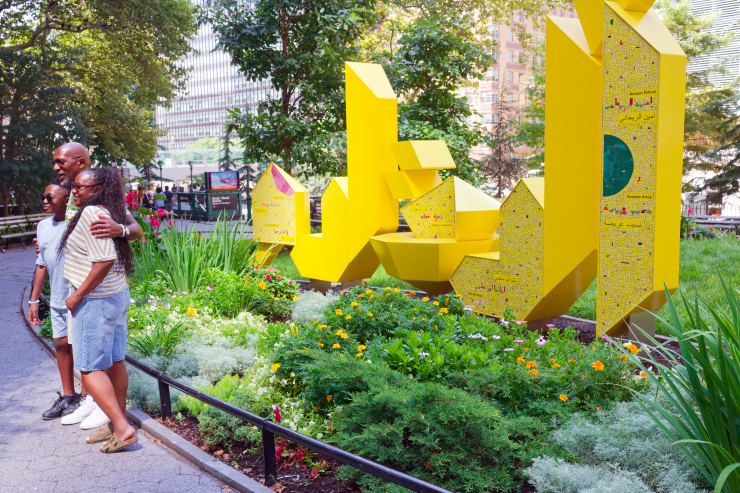 The monument, in Elizabeth H. Berger Triangle at Trinity Place and Edgar Street, includes a large sculptural piece and mosaic-tiled bench seatbacks that honors the Pen League [3], (also known as the Pen Bond), an association of Arab-speaking immigrant writers mainly active through the 1920s. But to understand who they were and where they came from needs explaining.
And that’s the hitch.
According to Lebanese officials and some Lebanese-American organizations, the text of the original sign, located near the new Sara Ouhaddou art installation “Al Qalam: Poets in the Park,” misrepresented the writers of Lebanese descent as Syrian. That’s a touchy issue given modern-day hostilities between the two countries. (Syria invaded Lebanon during the country’s civil war in the 1980s.) More importantly it’s complicated because the writers emigrated from a region that—until 1918—was part of the Ottoman Empire and known as Syria or Greater Syria. Four of the writers came from the province of Mount Lebanon before Lebanon as an independent country existed.
In May, Lebanon’s Minister of Foreign Affairs, Youssef Raggi, said in a Facebook post that he had directed Lebanon’s ambassador to Washington and consul general in New York to contact “the relevant authorities, with the aim of correcting the text in a way that is consistent with the known historical, cultural, and geographical facts, and that confirms the original and authentic Lebanese origins of these writers, who formed a main part of Lebanon’s cultural heritage in the world.”
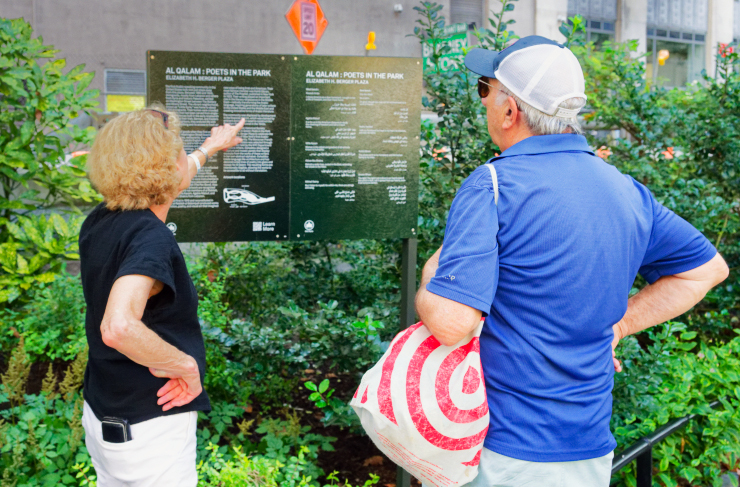 The “relevant authorities” were, in large part, the city’s Parks Department. According to a Facebook post by Shields of United Lebanon (SOUL), a Lebanese-American advocacy group that also lobbied for a revision, the Parks Department gave in to their demands. “We will revisit the historical sign text associated with this art project, and revise it for greater accuracy and clarity,” wrote Jonathan Kuhn, the Parks Department’s director of Art & Antiquities, according to SOUL.
Now that revision has its own critics, who say the rewrite goes too far in excluding references to Syria.
“Some changes were made without any sort of process, without the community board or any sort of scholarly input,” Todd Fine told Community Board 1’s Parks and Recreational Committee last month. As a scholar of one of the Pen League writers, Fine began lobbying the city 15 years ago to erect a monument to Little Syria’s literary past. He had co-founded the Washington Street Historical Society [4], which spent years shepherding the monument initiative through the city bureaucracy. (Fine is no longer a member.) He acknowledged that the original sign was “a little bit provocative” in what he believed to be an overuse of references to Syria and a lack of historical context. But, he maintained, the rewrite “doesn’t add any context at all. In fact, it removes the little context that was there and makes the situation a lot worse.” In one example he cited, some writers were identified as Lebanese while others were called Syrian.
 “It’s very ahistorical to make a distinction between Syria and Lebanon as two distinct areas in that period,” Fine said, calling the changes “something that divides people rather than unites people.”
Bob Madey said his grandfather, who was a member of the Pen League, considered himself Arab-American. “They did not identify specifically with a modern Lebanon or a modern Syria,” he said in an interview.
“This is an erasure,” he added, “of the writers and what they wrote about, how they stood on the colonialist project, and how they saw themselves.”
In addition, a co-founder of the Pen League, writer and journalist Abd al-Masih Haddad, goes unmentioned, both on the artwork and the sign. “Without his inclusion,” his great-granddaughter, Manal Abu-Shaheen, told the committee, “the monument is not fully representative of the Pen League and remains historically inaccurate.” His omission, she added, “also hinders public discovery and scholarship surrounding his important literary contributions.”
Following the installation of the monument, Linda Jacobs, the president of the Washington Street Historical Society, who is an author and scholar of Near Eastern archaeology and anthropology, and an expert on Little Syria, resigned from the organization. So, too, did two board members. Jacobs declined to be interviewed for this article. The two board members who resigned and two who are still on the board did not respond to requests for comment.
 A Parks Department spokesperson also did not respond to multiple email requests for comment.
Paula Hajar, who became the interim president of the Washington Street Historical Society following Jacobs’s departure, said in an email that, speaking for herself and not the organization, “I would be open to having this sign revised for greater clarity. Until that happens, though, I hope to fill in the gaps that the current sign leaves us with, through programming, specifically programs that showcase the work of all the Rabitah [Bond] members, including the work of the Pen League co-founder, Abd al-Masih Haddad.”
“Coming from Greater Syria is how the Arab American story has been told for generations,” she added.
But Hajar questioned the view of Fine and other critics that the sign should be rewritten by a group of “scholars” assembled by the Parks Department. Other than Fine and Jacobs, she said, there are few who have the necessary expertise, “and even among those few—and their audiences—there would probably be much disagreement.” She said Jacobs wrote the original text, with minor edits by the organization’s board.
CB1 decided not to take a position on the issue. Instead, Jennifer Lantzas, the Parks Department’s deputy director of Art & Antiquities, is expected to attend the board’s Executive Committee meeting on Aug. 25. The purpose, said Parks Committee chair Andrew Zelter, will be to understand the process for creating signage like this “and what played out in this specific instance.”
Links:
[1] https://tribecatrib.com/content/downtown-parks-enigmatic-art-honors-little-syria-and-its-literary-heritage
[2] https://www.nypl.org/blog/2015/11/19/manhattans-little-syria
[3] https://www.qnl.qa/en/blogs/12396
[4] https://washingtonstreethistoricalsociety.org/