
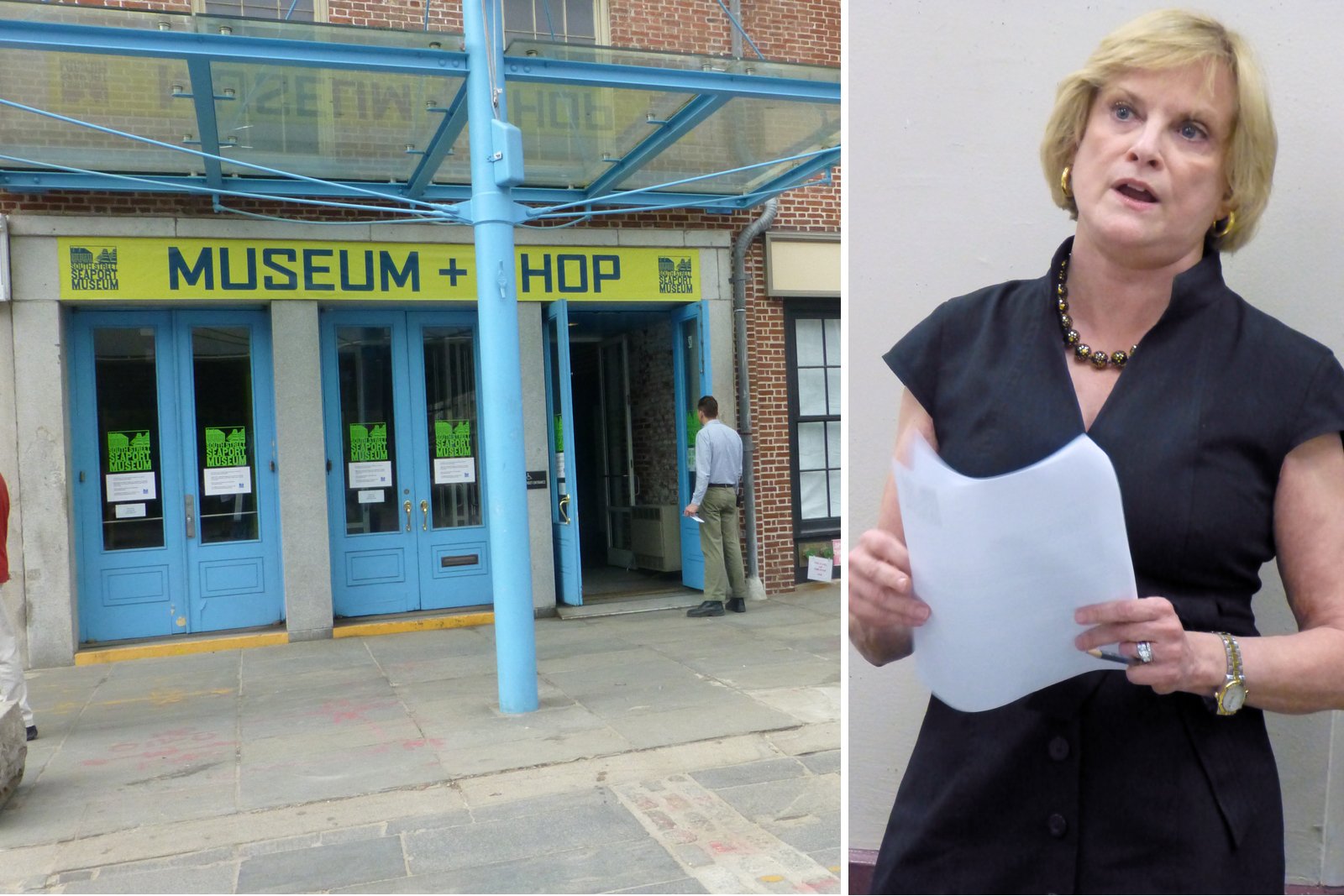
Susan Henshaw Jones, director of the Museum of the City of New York, at a Community Board 1 meeting earlier this year. On Monday, Jones issued a statement saying that, as of July 5, MCNY will no longer operate the Seaport Museum—dashing the community's hopes that it would extend its management role through the summer. Photos: Carl Glassman/Tribeca Trib
"Sandy did us in."
That was the long and the short of it from Susan Henshaw Jones, director of the Museum of the City of New York, who announced in a statement on Monday that her institution, which has kept the struggling South Street Seaport Museum afloat for nearly two years, would officially end the alliance on July 5.
As MCNY's contractual obligations to the museum, already extended from April, drew near, Seaport Museum supporters hoped for an 11th-hour rescue yet again.
But with the Seaport Museum still drowning in hurricane reconstruction costs estimated at $22 million, Jones dashed those hopes for good.
"Sandy ravaged our building systems and more," she said in the statement. "FEMA considers the Museum a 'nonessential nonprofit.' There is no clear path to receiving 'mitigation' funding. At the same time funding from FEMA will take years to receive.
"Thus," the statement continued, "the City Museum will not renew its operating agreement when it expires on July 5."
Jones touted the work of the Seaport Museum's "small but mighty staff" during MCNY's operation of the maritime institution for the past 21 months, including the mounting of 18 exhibitions, critical repairs to two historic ships (and fundraising to fix a third), and the reopening of Bowne & Co.—along with the launching, next door, of Bowne Printers.
"We were on a mission, and we had a vision," she said.
Community Board 1's Seaport Committee Chair John Fratta, who had asked Jones and her Board of Trustees to consider an additional four-month extension of the contract, was particularly disappointed not to have heard from Jones directly. A meeting the board requested to have with city representatives, along with MCNY and the Howard Hughes Corp., the major leaseholder of the Seaport, never materialized.
"I was hoping we'd have a heads-up that this was happening," said Fratta. "But it is what it was—now, we have to move forward and figure out how to save it."
Jones's announcement comes on the heels of a June 6 letter CB1 sent to Mayor Michael Bloomberg asking the administration to “intervene as soon as possible” in order to salvage the museum and its historic vessels.
"Community Board 1 has been working with the Seaport Museum in urging the Museum of the City of New York to extend [its] contract an additional four months," the letter read. "We believe this extension is critical in order to provide time in which the Seaport Museum, the New York City Economic Development Corporation and the Howard Hughes Corporation can communicate in order to ensure the preservation of the South Street Seaport Museum."
On Friday, the Economic Development Corp. reached out to CB1 chair Catherine McVay Hughes about a meeting it plans to arrange with the board, the Department of Cultural Affairs and elected officials to discuss the museum’s future.
Asked about the city’s plans for the Seaport Museum, Department of Cultural Affairs spokeswoman Danai Pointer said in an email that officials from her department had spoken to Councilwoman Margaret Chin and others to address the museum’s future. “The city is working on finding another entity that can steward the museum’s mission and collections. The Attorney General would have to be consulted if a steward is not found.”
Hughes, while anxious about the museum’s fate, credits its waterfront director Jonathan Boulware for protecting the six historic vessels docked at Piers 17 and 16 during Superstorm Sandy.
"I understand that the [museum's] 17-member staff is intact, and that Boulware...is still there," she told the Trib following a phone conversation with Jones Tuesday morning. "Boulware steered the vessels of the museum through Sandy, and I’m hoping that he’ll be able to steer the future of the museum through this difficult time, as well."
Hughes noted that museum supporters are pleased with the city’s grants disbursement of $1.5 million for the historic iron-hulled Wavertree and $400,000 for the repair of the Ambrose's crumbling deck.
Fratta is holding out hope that another institution will "step up to the plate” and take the helm. He and others voiced concern that, without a contingency plan, the museum—and its historical significance for the Seaport and the city as a whole—could soon be gone forever.
“Without the Seaport Museum, all we're going to have is a mall," he said, referring to the future Pier 17 structure. "The whole historic character of the Seaport is being destroyed, and it started with the [2005] loss of the Fulton Fish Market."