
$100 Million of TLC for a Hot and Weathered Chambers Street Station
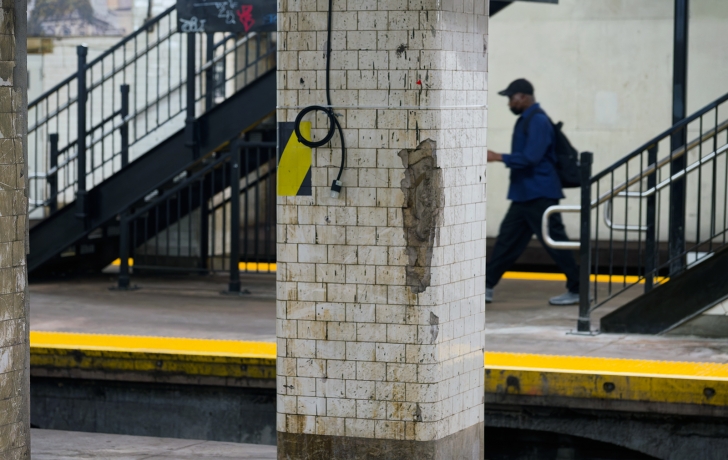
Replacement of tiles is part of the $100 million restoration of the J/Z Chambers Street subway station. Photo: Carl Glassman/Tribeca Trib
Better days are ahead for one of the city’s oldest and hottest subway stations.
Plans are afoot to restore the 113-year-old Chambers Street J/Z station “from top to bottom,” as well as study ways to bring down its sweltering temperatures and recycle the heat.
Gov. Kathy Hochul last week announced the MTA project, which will replace tiles, upgrade stairways, fix leaky ceilings and restore architectural details of the station, which is on the National Register of Historic places.
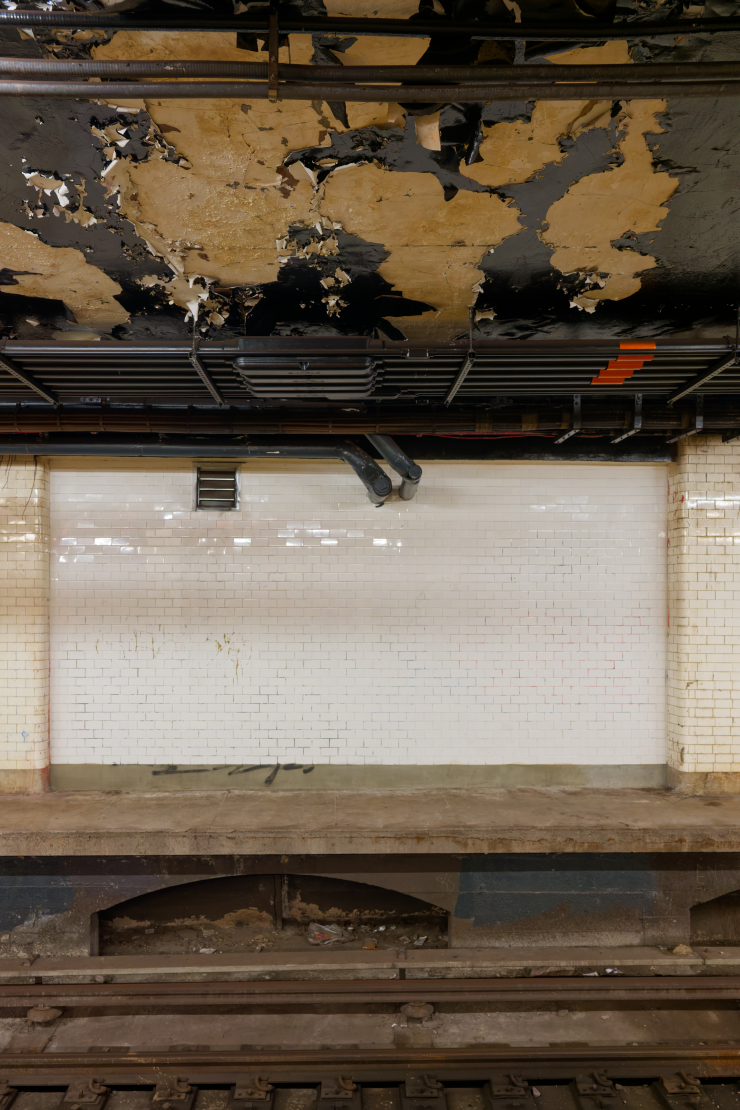 The estimated $100 million project will be paid for by revenue from congestion pricing.
In addition, Hochul, along with MTA and city officials, announced on Monday they are launching an $800,000 pilot study to see how excess heat from the station can be captured and stored in order to heat several nearby city buildings, including the Municipal Building and Tweed Courthouse, during cold months. The process, called Thermal Energy Networks (TENs), is in use at St. Patrick’s Cathedral, the New York Botanical Garden, and in other countries, but this would be its first test in a U.S. transit system.
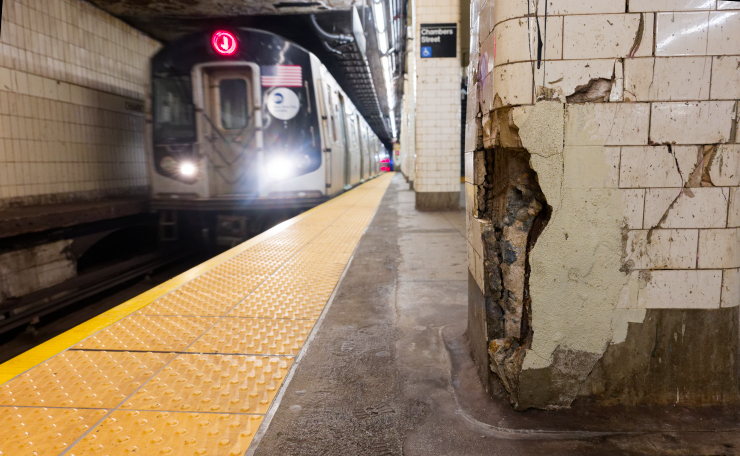 “We’re excited because it could be a real win-win: cooler stations for our subway riders, and the city of New York gets to save on energy costs potentially,” MTA chair and CEO Janno Lieber said during a news briefing at the station.
It costs $1.4 million a year just to heat the Municipal Building, Comptroller Mark Levine said at the event.
Lieber noted that last year the station’s average temperatures peaked at 96 degrees; it is unclear how it can be lowered by the heat transfer method.
“We want to see if we could get it down a few degrees,” he said. “That would make the difference between total misery and merely sweltering on some of our worst days.”
“We’re not going to create an office air-conditioned environment,” he added, “but our goal is to improve it dramatically.”
Mayor Zohran Mamdani said the city is aiming to confirm the feasibility of the method by the end of this year. If it is found to be doable, he said, design work could begin as early as next year.