
Outside City Hall Park, a Hub for Helping Beleaguered Delivery Workers
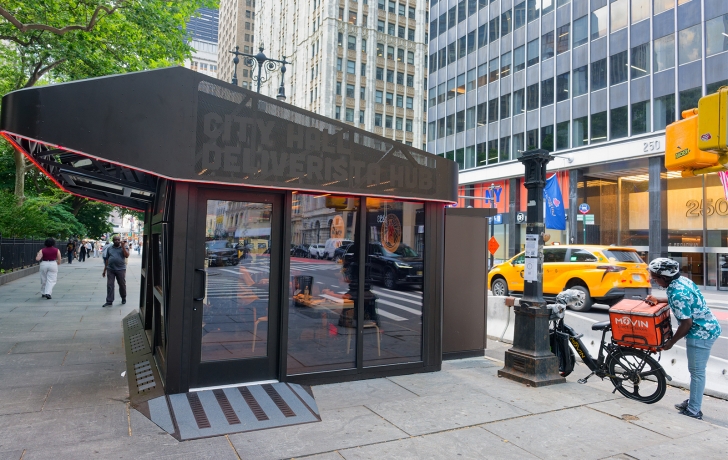
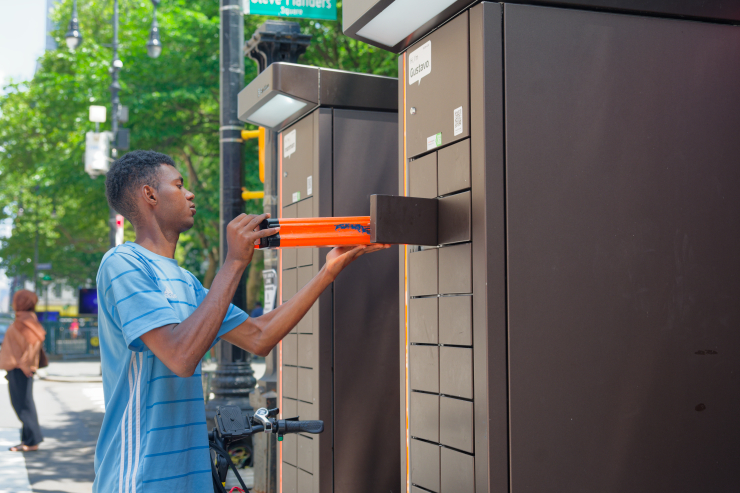
The City Hall Deliverista Hub, located on Broadway outside City Hall Park, went into full operation last month. At right, a delivery worker arrives to swap batteries for his electric bike. Photo: Carl Glassman/Tribeca Trib
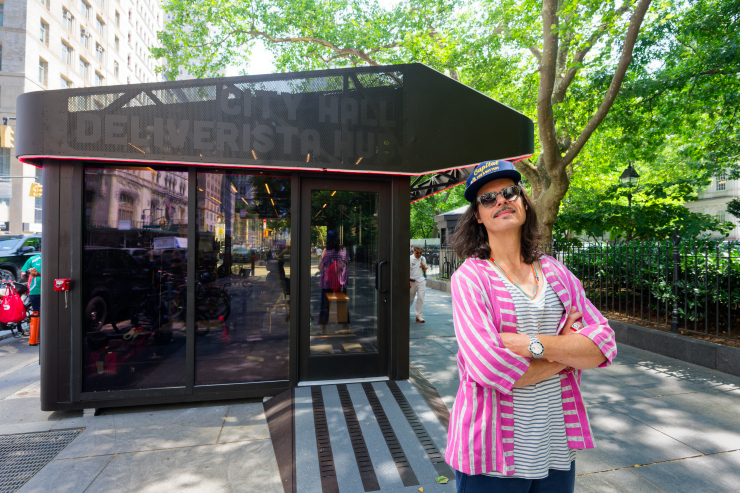
You may have noticed a dark, glass-and-aluminum structure outside City Hall Park, and wondered: What’s going on in there?
Called the City Hall Deliverista Hub, it’s the city’s first and only way station where food delivery workers can swap out e-bike batteries, get bike repairs, and—perhaps most importantly—receive support in their often fraught relationships with the delivery app companies that employ them.
Born out of the Worker’s Justice Project (WJP) during the pandemic to protest unsafe and unfair working conditions, the hub has become a lifeline for many of the delivery workers, often called “deliveristas” from the days when most delivery workers came from Latin America. (Today, the majority of delivery people are natives of West Africa and the West Indies.)
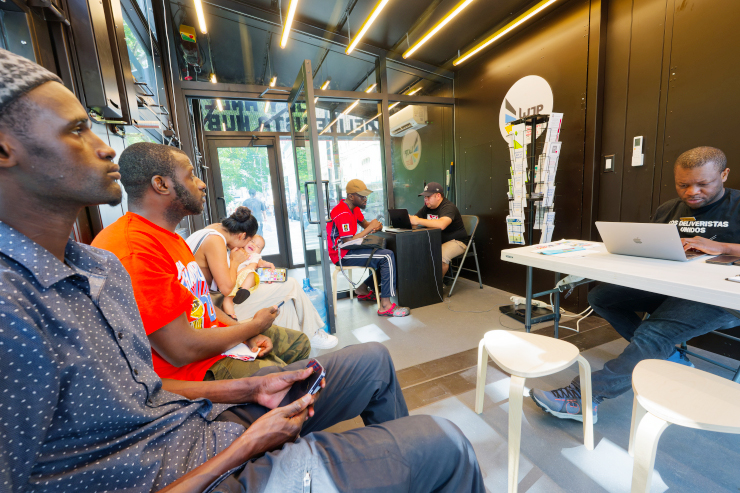
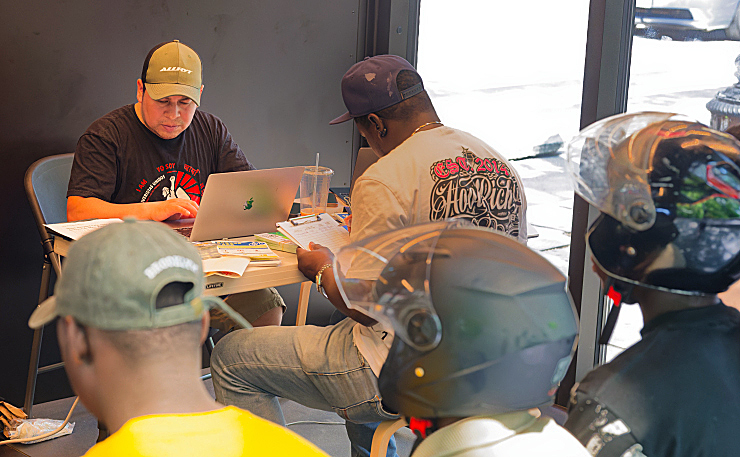 Each weekday, 20 to 30 delivery people arrive for help from the WJP reps, most because they had been “deactivated” by one or more of the three major delivery apps: UberEats, DoorDash and GrubHub.
“We have contacts with all the companies so we send them the cases,” said Gustavo Ajche, a co-founder of the WJP’s Los Deliveristas Unidos. The Guatemala native originated the hub idea and is on hand three days a week to advise the workers.
“We don’t have that much knowledge, but we do our best to provide help,” Ajche said, noting that they manage to get about 80% of the cases reactivated, though some workers, he acknowledged, are let go for good cause.
And then there is the issue of safety—not only for the workers, but for pedestrians who walk in fear of being struck by the e-bike of a speeding deliverista. “We try to improve the safety for everyone,” Ajche said, by emphasizing the need to follow traffic laws. “It’s so wild on the street.”
 “It’s not the workers who want to go rushing down the street, it’s the apps that are pushing workers,” Ajche noted. “They’re always finding ways to make workers go faster and faster on the street because if the food is late, it’s against the worker.” With a long waiting list of potential workers, Ajche said, app companies view the individual deliverista as expendable.
One day recently, Guinea native and current Bronx resident Thierno Bah was at the hub, sharing his story with Ligia Guallpa, executive director of the WJP. Bah explained he had recently been deactivated by both UberEats and GrubHub, adding that the apps’ justification was invalid. “They told me that it’s the [order] cancellation, but my cancellation was under four percent.”
Later, Guallpa explained to the Trib: “Often when they get to the restaurant, somebody else already picked up the order, or there were issues with the order, either from the restaurants or from the consumers, so they have to cancel the order. And when they cancel the order, regardless of whether it’s the deliverista’s fault or not, the apps blame them by putting a negative rating. When they do a negative rating, it triggers a deactivation. So they get fired.”
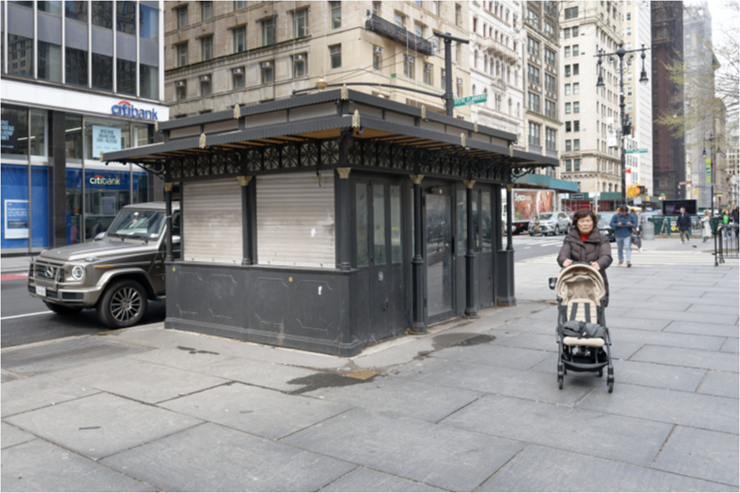
 A joint project of the city’s Parks Department and Worker’s Justice Project, the structure replaced a newsstand that stood on the same spot for 44 years. Community Board 1 and the City Hall Park Conservancy opposed the kiosk, largely due to its location, but the Landmarks Preservation Commission greenlighted it in April 2024. Nearly two years later, the newsstand, a longtime neighborhood fixture, was demolished.
“When I first got elected [in 2009], this was the easiest place to go grab a quick snack,” Jumaane Williams, now the city’s Public Advocate, said following the hub’s ribbon cutting ceremony. “Now they don’t have a lot of those kiosks anymore. I do miss them, but I know COVID came and shut down a lot of things that people were used to. I’m just glad the space is being used for something that is going to be beneficial to the community. And I think it’s even better than what was there, quite honestly.”
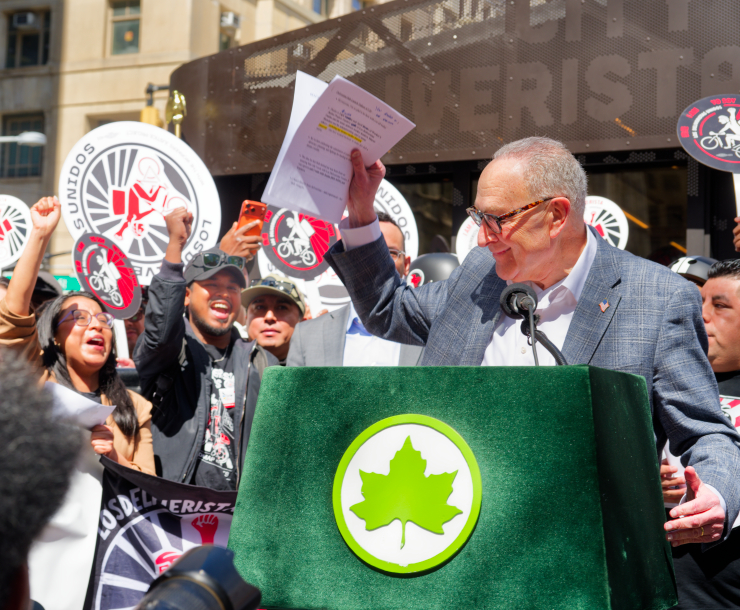
 The kiosk became fully functional last month, two months after its April 7 ribbon cutting, delayed by electrical problems and other unfinished work. Among those at the event was Sen. Charles Schumer, who was instrumental in pushing the project forward after a bike ride with delivery workers at the height of the pandemic. He took on their cause, pledging to use part of a $1 trillion bipartisan infrastructure package to build rest areas for workers. It took five years for the hub—the first of its kind in the city—to materialize.
“The convenience of being able to zoom by and just basically do a drive-through experience where you swap the battery and continue on your way down Broadway is very convenient,” said the hub’s designer, J. Manuel Mansylla, of the urban design firm Fantástica.
 Workers, who pay a fee to swap batteries at the kiosk, scan a QR code, which opens one of 50 drawers in two rows of battery cabinets. They insert their spent battery into one port, remove a fully-charged one from another, and off they go.
Deliveristas were slow to take to the hub—in April there were only 39 battery swaps—but that jumped to 2,286 in June and the Workers Justice Project expects that number to continue to grow.
While some have complained that the Swobbee batteries last only about two hours, most of the the deliveristas we spoke to are satisfied with the service, and for one reason in particular: they no longer have to charge e-bike batteries at home, which is not only time-consuming, but a potential fire hazard.
Joshua Wood, who started delivering for Postmates a decade ago and now works as a bike messenger and Los Deliveristas Unidos organizer, calls delivery work “grueling” and believes the multi-billion-dollar app companies should foot the bill for worker infrastructure.
“In an ideal world,” Wood said, gesturing to the kiosk, “these would be in every neighborhood, paid for by the app companies. In the world that we live in, it took us around five years to get this one built. We have others in the works, hopefully in the next year or two. So it’s one small step in the right direction.”