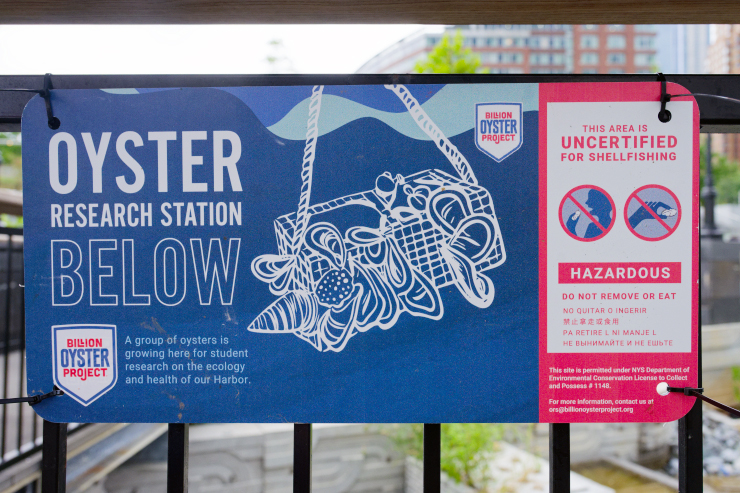
Oyster Research Station Launched on Battery Park City's New Tide Deck
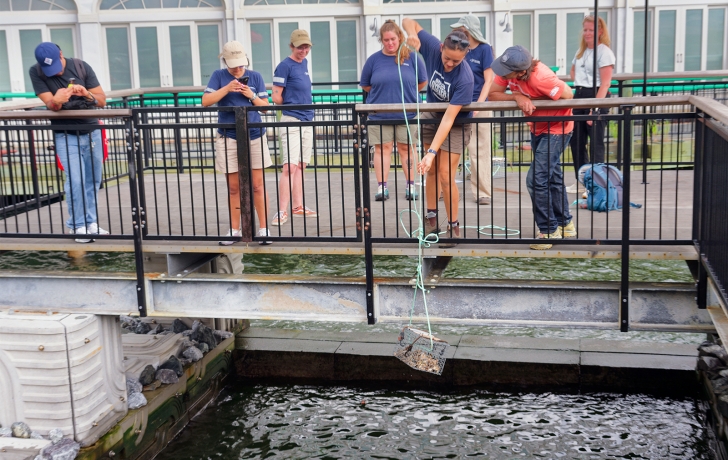
At the kickoff of Battery Park City's Oyster Research Station program, Amelia Lang from the Billion Oyster Project lowers a cage of oyster shells and live oysters into the inlet waters between Wagner Park and Pier A. At the top of the cage are ceramic tiles, which provide surfaces for other, often non-moving marine organisms to settle and grow. Photo: Carl Glassman/Tribeca Trib
Oysters have a new home in Battery Park City.
The neighborhood launched its own Oyster Research Station program last week on the tide deck off Wagner Park, across from Pier A. There the bivalves along with other marine creatures will be studied, providing new scientific data as well as opportunities for educating the public about oyster growth, marine biodiversity and water conditions around New York City.
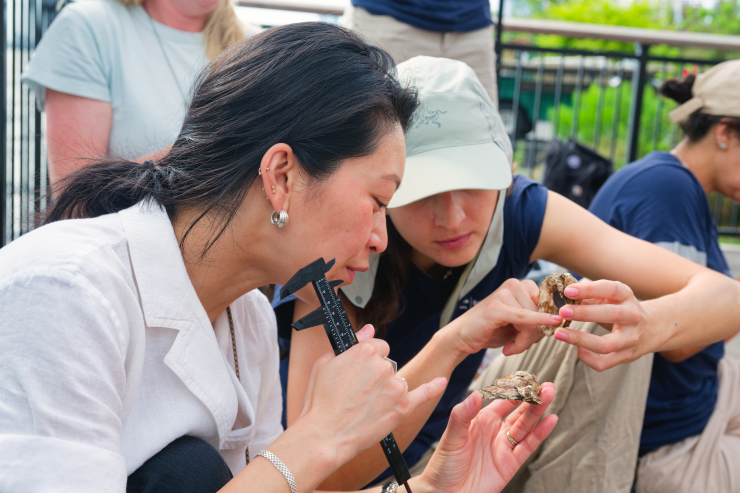
.jpg "With the help of hands-on instruction (top) and the use of graphics (above), Maya Ethridge, a BPCA environmental education assistant, gives visitors brief tutorials on oyster anatomy. Photos: Carl Glassman/Tribeca Trib") The station is a project of the Battery Park City Authority and the Billion Oyster Project.
The station is a project of the Battery Park City Authority and the Billion Oyster Project.
During the kick-off program on Aug. 20, students and BPCA staff received an introduction to oyster monitoring, with the first oyster research cages lowered into the river. For the ongoing program, Marieke Bender, the BPCA’s outdoor educator who was trained by the Billion Oyster Project, will be pulling up the cages for school groups and others to get hands-on learning opportunities. They will measure the oysters, and find out about the animals’ role in cleaning the water and gain insights into the estuary’s health. (An estuary is where fresh and salt water mix.)
.jpg "Kids inspect oysters under the guidance of Amelia Lang from the Billion Oyster Project. Photo: Carl Glassman/Tribeca Trib") The new tide deck, where the program is stationed, is part of the South Battery Park City Resiliency Project and the only place in the neighborhood where you can step out over the water, noted Sarah Fisher Curtin, the BPCA’s director of sustainability. “The esplanade is a delight. But you can’t get water on either side of you. Here, you can get into the inlet.”
The new tide deck, where the program is stationed, is part of the South Battery Park City Resiliency Project and the only place in the neighborhood where you can step out over the water, noted Sarah Fisher Curtin, the BPCA’s director of sustainability. “The esplanade is a delight. But you can’t get water on either side of you. Here, you can get into the inlet.”
“It’s a great way to get people to the water’s edge,” she added, “and learn about what’s happening down there.”