
Q&A: Turning a Page in Life, a Tribeca Couple Becomes Thriller Series Authors
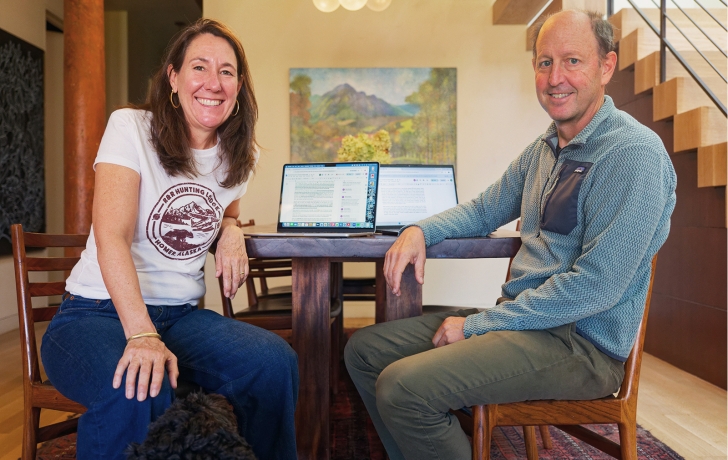
Karen and Bill Brodsky, at home in Tribeca. Photo: Carl Glassman/Tribeca Trib
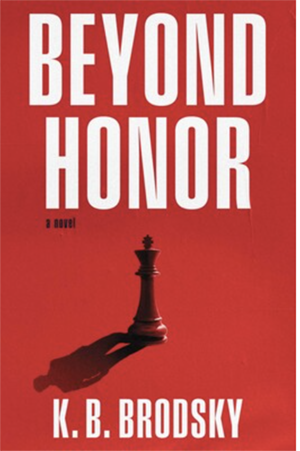
Karen and Bill Brodsky are longtime Tribeca residents who are now a writing team under the nom de plume K.B. Brodsky. Their first book, an international political thriller called “Beyond Honor,” was published last month by Emily Bestler Books/Simon & Schuster. “This is the authors’ debut and they nailed it,” a starred Kirkus review raved. The couple has completed a second book in the series and are at work on a third. This is a second life for both Bill, a real estate developer, and Karen, who has devoted herself to volunteer work and their family. The following Q&A comes from a discussion at the book’s launch last month at Tribeca’s The Mysterious Bookshop, and from an interview with the Trib.
Q Has writing a novel been something you've been thinking about for a long time?
Bill I didn’t know I was a writer. But I have always been a very voracious reader and I love reading these kinds of books. We were living in Colorado where there is a self-portrait of an artist hanging on the wall, a very moody picture in blues and grays. I looked at it and I felt I knew a fictional story about him.
I’ve listened to podcasts and I’ve read so many espionage genre fiction books. I feel like I’ve read all of them. I knew the tropes in the genre. So I just kind of started to peck away in the morning, before Karen woke up. I was embarrassed to tell her.
Q Karen, did you ever think of yourself as a writer?
 Karen I’ve always wanted to write. I’ve taken writing classes and I have my own novel that Bill’s always said, “Do it. Do it,” but I never had the discipline or the confidence to devote the time to getting it done, which is why when he sat down and knocked out the first draft of this book on the sly, I said "What?" I was like, I’m not going to work on your book. I have my book. And then I thought, well, I’ve had 15 years to finish that book, and I haven’t, so I’ll do this one first. Someday at the end of this journey, I’ll get that one out.
Q Did you disagree over characters and other things? Or did you always see eye to eye?
Karen We didn’t always agree. And I think the book’s better because of it. Working together, disagreeing, and talking it out. Bill doesn’t like to fight about things the way I do. So I would push and push. But basically, whoever cared the most about what we were fighting about, the other person just gave in. And I think it helped the book.
Bill really is the architect of the plot. And then I come in and start looking more at the structure, the narrators and dialogue. The whole time we’re having conversations about the characters. Where are they going? Is this working? Do we need this?
One thing that we talked about a lot was that we wanted something to happen to all the main characters that would push them beyond honor. Some of them are pretty weak characters, and they bend really fast, and some of them have to be pushed really hard. But at the end, everybody is in a different place than they began. We really worked together to try to find those points to make sure that we felt like their journeys all hold water.
We work collaboratively, and the deal is that every single comment, every edit gets saved, and nobody can change anything until the other person accepts the change.
Q Are there authors in this genre who influenced you?
Bill The genre has evolved over time. Maybe Ian Fleming is cartoonish in hindsight. Today a lot of people’s books in this genre are very action-oriented, which are super fun to read. But ours is a little bit of a throwback, I hope, to the Tom Clancys and the Robert Ludlums and the Dave Morrells of the world. It’s slowed down a bit and the action is meant to serve the character's arc as opposed to the action as the driver of the story.
Q Karen, had you been a reader of this genre?
Karen I do read the genere but read more widely. Over the years there were a bunch of books that Bill said, “I think you’d really like this,” but I found either the writing was lazy, or it was just like all action, too male, and not enough plot development. When we started working together, it was really important to me that there were characters I could sink my teeth into, and that we cared about all of them. As Bill says, we made this very conscious choice that the characters drive the plot, not the other way around. So it’s not like, “Let’s make something exciting happen, and we'll wedge these characters into it.” It was “Let’s make something exciting happen,” because we want them to end up at a certain place at the end of the book.
Q Bill, how has your career as a real estate developer influenced your work as a writer?
Bill The development business is about organizing lots of different vendors, architects, engineers, interior designers, contractors, plumbers. You're trying to organize that in a way to motivate them to get to the North Star, which is the building. And I think in the same way there are different storylines within this bigger story, and we're trying to organize them so they're all moving towards our North Star, which is an exciting book.
I’ve never said that out loud, but I have thought about it.
Q How has becoming authors changed your lives?
Bill I think it’s been really interesting to do something different as we’re approaching middle age—or maybe on the other side—of middle age, to explore a different business, to do something more creative, to do something together. Our kids have grown up and left the house. I spent 25, 30 years working. I’d leave in the day, come back at night. I wouldn’t want to talk about real estate. It's just so different working with Karen. It makes it even more fun to share the excitement; It's a surprise little journey.
Karen It’s not a job where you show up at 9:00 and you leave at 5:00. We’re constantly thinking about the book, talking about it, reading, researching things. I feel like we’ve been plopped into another person’s storyline. It happened so fast, and it wasn’t like we planned it. We changed lanes and we’re doing this other life now.
Q And how has this new life affected your kids, if at all?
Karen You know, when you’re raising kids, it’s all about their achievements, their successes, and I think they’re having a really fun time turning the tables, seeing us as a role model and realizing that when you hit our age, you're not just packing it up. You can still explore new sides of yourself.
Bill We were talking about that the other day with our daughter Skye and she said, “You know, if I don’t want to be a teacher anymore and I want to do something different, I see what you and Mom have done, and I feel very confident I could try something new.”